
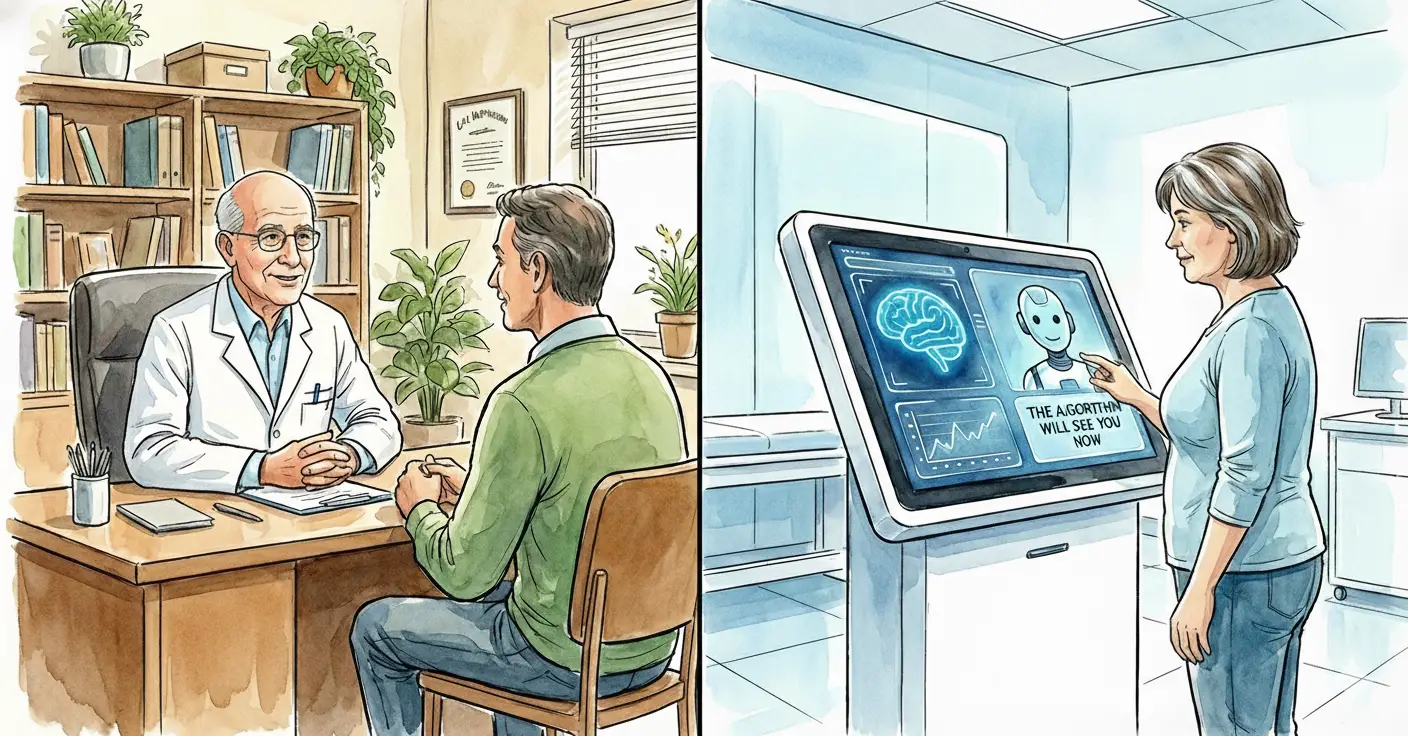
In a recent issue of Men’s Health, Dave DeBronkart tackles artificial intelligence in healthcare with refreshing honesty. His piece, “Robo-Revolutionize Your Health,” avoids the typical Silicon Valley hype while acknowledging that A.I. can be genuinely useful—and genuinely “scary.”
DeBronkart’s examples are convincing. Burt Rosen used ChatGPT to decode his medical reports. Courtney Morales Hofmann employed A.I. to identify her son’s undiagnosed condition. These aren’t theoretical benefits but practical wins against a healthcare system that often leaves patients drowning in incomprehensible information.
What sets DeBronkart apart is his treatment of A.I. as a sophisticated reference tool rather than an oracle. He emphasizes verification, precise prompting, and healthy skepticism—the understanding that even advanced algorithms are, fundamentally, confident guessers. This perspective feels adult in an era of breathless tech evangelism.
The broader implications are significant. DeBronkart envisions A.I. helping doctors with administrative tasks, assisting with diagnoses, and improving patient education. The traditional asymmetries of medical knowledge might begin to flatten, transforming patients from passive recipients into informed participants in their own care.
Whether this vision survives contact with America’s actual healthcare system—with its insurance labyrinths and profit-driven priorities—remains unclear. But DeBronkart offers a practical roadmap for navigating these changes. He demystifies A.I. without overselling it, encouraging readers to engage with technology as informed consumers rather than true believers.
In a healthcare landscape where medical bills arrive faster than diagnoses and patient consultations last minutes, artificial intelligence might not represent the future so much as a more honest version of the present: efficient, occasionally helpful, and requiring constant supervision. DeBronkart’s guide suggests that in this new reality, the best patients will be the best-informed ones.